By Dr. Eduardo Mayorga
In a past blog we talked about how we use Google Docs for enhancing reflective learning.
Today we will see how we take this reflective learning to the operating room.
At our residency, residents must record on video all their surgery. Every week they must choose 2 segments: the one they feel was their best performance and the one they think was their worst. They must upload these segments to Youtube.
On a Google Docs spreadsheet they record the date, instructor, link to the video and reflection on their performance.
This is not only useful for the resident that reflects on his or her performance, but it also helps build a video collection for training other residents.
Adequate sharing settings are setup up to assure privacy.
Wednesday, December 29, 2010
Saturday, November 27, 2010
Irfanview - Working with Images with ease
Dr. Anthony Vipin
As Teachers and Students presenting Powerpoints regularly, working with different Image types and sizes can be demanding and confusing. I have found this Freeware viewer called IRFANVIEW of great help and thought I should share some aspects of this tool with you.
IrfanView is a freeware/shareware image viewer for Microsoft Windows that can view, edit, and convert image files and play video/audio files. It is noted for its small size, speed, ease of use, and ability to handle a wide variety of graphic file formats, and has some image creation and painting capabilities. The software was first released in 1996. IrfanView is free for non-commercial use; commercial use requires paid registration.
The program is named after its creator, Irfan Skiljan from Bosnia and Herzegovina, living in Vienna. IrfanView works under Windows 95 through Windows 7. It supports numerous file types including: image formats such as BMP, GIF, JPEG, PNG (includes the optimizer PNGOUT), TIFF, camera RAW, non-image media files such as Flash, Ogg Vorbis, MPEG, MP3, MIDI, and text files.
Irfan View
Version 4.27
Basic Install - 1.6 MB, Full Install with Plugins - 10 MB
Note - During installation, when prompted to select type of files to be associated, click IMAGES ONLY. (This is not required if you want to keep your actual association)
If you associated images to IrfanView you will see all images with a Irfanview cat Icon! According to Skiljan, the IrfanView logo and mascot is a "road cat" (there is a tire track across the smallest icon)File Support -
A wide range of files can be opened. They can be converted into a wider range of Image types. Most commonly I work between BMP, PNG, TIFF and JPEG and I find using this much easier. The option to be used is Save As -
Resize -
This is the BEST option that allows us to conveniently resize Images to any size to enable embedding into presentations or to upload as thumbnails on websites. Hotkey to be used is Ctrl + R
Rotate -
Another simple effective function. Press L for Left and R for Right. Its that Simple!
Paint Tool -
After a selection is made, Paint tool can be used to further add to the picture like color coding, labeling. Hotkey - F12
Crop Selection -
The detail and precision of this tool is amazing. By default when you open an image, you get a cross hair which enables you to conveniently select your area of interest to crop. Once selected, all the four corners and lines can be moved independently to further refine the selection. I have found this tool of great help to work parallely between Powerpoint and Irfanview.
Photo enhancement options -
In Image, there are a wide variety of Color filters, Convert to Grayscale, Negative, Red Eye reductions, Effects to add to the images or selections. The functions are endless.
Viewing ease -
Hitting ENTER automatically makes the Image full screen, and hitting Esc key while open closes the application. Minute attention to detail like this makes it more user friendly.
Irfanview is a small sized software that packs a Big Punch. As a freeware application, it has gained wide spread popularity around the Globe. I have mentioned only a FEW functions that I use regularly to edit images crisply and efficiently. You can use the help option to explore the other functions as well.
I would highly recommend you all to try it out and you'll see the difference! It is FREEWARE! :)
Homepage ( Download )
www.irfanview.com
FAQs
http://www.irfanview.net/faq.htm
Friday, October 29, 2010
Managing Content in the Web 3.0 era
How to keep current using RSS feeds
By Helena Filipe
By Helena Filipe
The latest response of technology to our needs to find and organize information is the so called semantic, data Web or Web 3.0.
This kind of artificial intelligence extracts meaning from the way people interact with the web and contextualize information search according to one’s goals and interests.
A great number of blogs, journals and other online applications are now producing RSS (Really Simple Syndication ou Rich Site Summary) and Web Feeds.
Every blog or other online application with RSS icon in its page can be listed and aggregated.
Clicking the correspondent icon enables us to subscribe the ones of our preference and list them as favourite sites.
The following screenshots show the sequence of steps required to add the blog “elearnspace” to your list of favorites.
After clicking the icon in the box, a dialog box will appear inviting us to add our feed to our iGoogle homepage (first option) or using Google Reader (www.google.com/reader) (second option) as an aggregator to list it in our group of favourites that we can check with Internet Explorer.
Choosing iGoogle page will help up us personalising our homepage, and a miniaplication will immediately appear in our homepage. To create our own iGoogle page we must have created an account and it will be accessed by our username and password which can be the same ones that we use to open our Gmail.
If we decide ourselves for storing the feed in our personalized iGoogle page it will automatically appear whenever we enter the page and immediately announces if there is something new to capture our attention.
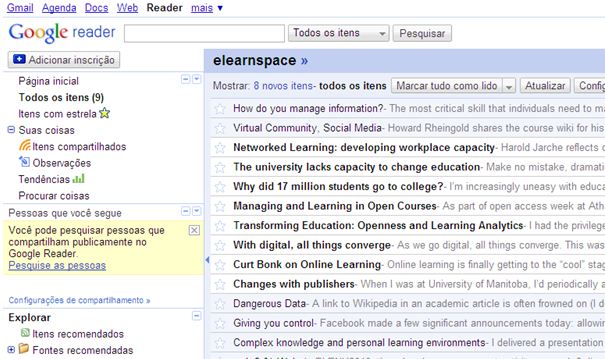
If we choose Google Reader as an aggregator, we must create an account (again, possibly maintaining our Gmail username and password) and after logging in, the following screen will be displayed.
We can check the list of postings of our newly added site as well as consult the others we have previously added.
We will just focus on what we really need and we will be easily updated on new content of the sites of our preference.
You can also subscribe this feed and add it to the Central Feed Centre.
As such we will be creating our own list of favourites that can be checked with Internet Explorer.
New content of other added sites are at a click’s distance. We can add as many we need. They can then be selected from the list of our left.
The next screen shows an example of us checking new content of sites we already had in our list.
New content of our previously chosen sources will be pulled to us instead our going to look for it.
This information sharing structure allows both learners and educators to manage content, avoiding a paralysing sea of information as well as to create one’s personal enriching learning environment.
Wednesday, September 29, 2010
Following up residents' assignments
Haven't you found yourself giving assignments to residents or coworkers through email and realize weeks or months latter that these assignments were not carried out? If so, how do you deal with them?I used to do it with my "To do" list but, on one hand, this made my "To do" list very long and on the other one, running down every day your "To do" list is not only time consuming, but many times you don't do it at all.
How can we keep an uncluttered "To do" list and at the same time, be reminded timely about the tasks you must follow up?
I have found "Deferred Sender" at http://www.deferredsender.com/ a very useful tool. Deferred Sender is a free service that allows you to schedule emails from any email application or website to be sent in the future.
The way I make it work for me is that every time I send out a task through my email, I just copy it to "deferred@deferredsender.com" with my email and the date on which I want to be reminded about the task. On that date, it will enter my email box and sit at the top of the unread mail to remind me about the task.
You can find more information at http://deferredsender.com/help
Monday, August 30, 2010
“Making your lectures interactive using the cell phones of attendants”
By Dr. Eduardo Mayorga
One of the drawbacks of lectures, from the pedagogical standpoint of view, is that they may lack interactivity. If present, you can only have it with a very small portion of the audience.
When working with your residents in small groups, interactivity can be maintained, but once you have asked an open question and one resident answers, you will never know if the rest had the answer in mind.
To overcome these two drawbacks, you may want to add an 'interactive answering system' to your teaching tools,.
An interactive answering system is usually composed by some kind of hardware that allows participants in a meeting answer to a multiple choice question that the presenter has posted on the screen. Through special software that receives the answers, the presenter can show the results on the screen. The following images show an example of answering hardware and the results of the answer.
These answering systems have the disadvantage that you have to purchase all the answering devices.
At our residency we use a system that allows using the cell phones as answering devices. In this way we had to purchase only the software that can connect to a cellphone or a modem of a cellphone communications provider. In our case we use the modem.
With this method we can receive interactions from any size of audience. The results shown on the previous image come from the system we use.
One advantage is that you can also receive complete text messages for open questions. Following is an example from a small group of residents that were asked to define the acronym: LASEK.
As you can see, you get all kind of versions. The nice thing about the system is that you can display the results as they enter, or show them all at a time, once the last answer entered.
You can read more about SMS Studio, the software we use, clicking here.
We have no financial interest in this software.
One of the drawbacks of lectures, from the pedagogical standpoint of view, is that they may lack interactivity. If present, you can only have it with a very small portion of the audience.
When working with your residents in small groups, interactivity can be maintained, but once you have asked an open question and one resident answers, you will never know if the rest had the answer in mind.
To overcome these two drawbacks, you may want to add an 'interactive answering system' to your teaching tools,.
An interactive answering system is usually composed by some kind of hardware that allows participants in a meeting answer to a multiple choice question that the presenter has posted on the screen. Through special software that receives the answers, the presenter can show the results on the screen. The following images show an example of answering hardware and the results of the answer.
These answering systems have the disadvantage that you have to purchase all the answering devices.
At our residency we use a system that allows using the cell phones as answering devices. In this way we had to purchase only the software that can connect to a cellphone or a modem of a cellphone communications provider. In our case we use the modem.
With this method we can receive interactions from any size of audience. The results shown on the previous image come from the system we use.
One advantage is that you can also receive complete text messages for open questions. Following is an example from a small group of residents that were asked to define the acronym: LASEK.
As you can see, you get all kind of versions. The nice thing about the system is that you can display the results as they enter, or show them all at a time, once the last answer entered.
You can read more about SMS Studio, the software we use, clicking here.
We have no financial interest in this software.
Friday, July 30, 2010
Electronic Portfolio using Google Docs Folders
By Eduardo Mayorga
A learning portfolio is a collection of products (learning experiences), prepared by the resident, that provides evidence of learning and achievement, related to a learning plan.
So the key aspects that are generally recorded in the portfolio are:
The evidence: a demonstration of how the learning is being applied in an appropriate context;
the learning: the discovery that what was has been recalled has significance in the future;
the evidence: a demonstration of how the learning is being applied in an appropriate context;
the learning needs: an identification of where it would be appropriate to go next;
the learning opportunities: an educational plan identifying ways in which learning needs might be met.
Some concrete examples of the components that ay be included in a portfolio are, among others:
A learning portfolio is a collection of products (learning experiences), prepared by the resident, that provides evidence of learning and achievement, related to a learning plan.
So the key aspects that are generally recorded in the portfolio are:
The evidence: a demonstration of how the learning is being applied in an appropriate context;
the learning: the discovery that what was has been recalled has significance in the future;
the evidence: a demonstration of how the learning is being applied in an appropriate context;
the learning needs: an identification of where it would be appropriate to go next;
the learning opportunities: an educational plan identifying ways in which learning needs might be met.
Redman 1994: Portfolios for development
Some concrete examples of the components that ay be included in a portfolio are, among others:
•Curriculum Vitae (CV)
• Publications
• Research literature review when selecting a treatment option
• Log of clinical and surgical procedures
• Ethical dilemmas faced (and how they were handled)
• Faculty evaluations
• 360-degree evaluations
• Copies of written instructions for patients and families
• Case presentations, lectures, logs of medical students mentored
By the end of his or her third year, paper portfolios can get very bulky. Besides this, residents start forgetting their paper folder at home. Reviewing residents' portfolios can be an impossible task if one wants to take home the work.
One way of avoiding all these shortcomings is using an electronic portfolio.
Goggle Docs http://docs.google.com/ is an excellent tool where residents can store their activities and share them with faculty. Any document that is not originally electronic is scanned and kept as a PDF document.
In our residency, each resident keeps 2 folders one with the results of exams, shared only with faculty, and one with the rest of the portfolio, shared with faculty and rest of the residents.
To be kept in order, each resident folder starts with the year the resident entered the residency program, as seen in this image:
The shared folder contains the rest of the sub-folders mentioned above:
You can learn more about folders at
http://docs.google.com/support/bin/answer.py?hl=en&answer=158074
Monday, June 28, 2010
Using Googledocs Spreadsheets for Developing Reflective Learning Narrations
Reflective narrations serve many purposes in residents’ education. Firstly, by reflecting on what has been learned and how this learning is being applied to practice, residents and their tutors can identify knowledge gaps and other learning needs, and develop a learning plan that could help meet those needs.Secondly, self-reflection and critical incident reports allow residents realize how these events are influencing their present and future practice.
Finally, by reading residents’ narrations teachers are able to better understand the resident’s thinking process, and how he/she arrived to a conclusion or made a mistake.
Every day, after they have finished their rotation shift, residents in our department reflect on and write a brief narration describing the 2 or 3 most important concepts they consider they have learned that day at the clinic or in the operating room. We have recently migrated from a paper form to a Google docs Spreadsheet, which has the advantage that residents can write as much as they need, and we teachers can read narrations from home at our convenience. The document includes columns for date, rotation, teacher or book where they got the information, teacher’s or program director’s comments and resident’s response, and it is included in the resident’s learning portfolio.
We have found this online “Daily Learning Form” (as we call it) user-friendly and very convenient for all participants involved, for it combines the benefits of mental reflection and web-based teaching.
Subscribe to:
Posts (Atom)